
Launch the interactive dashboard version of this article
Abstract
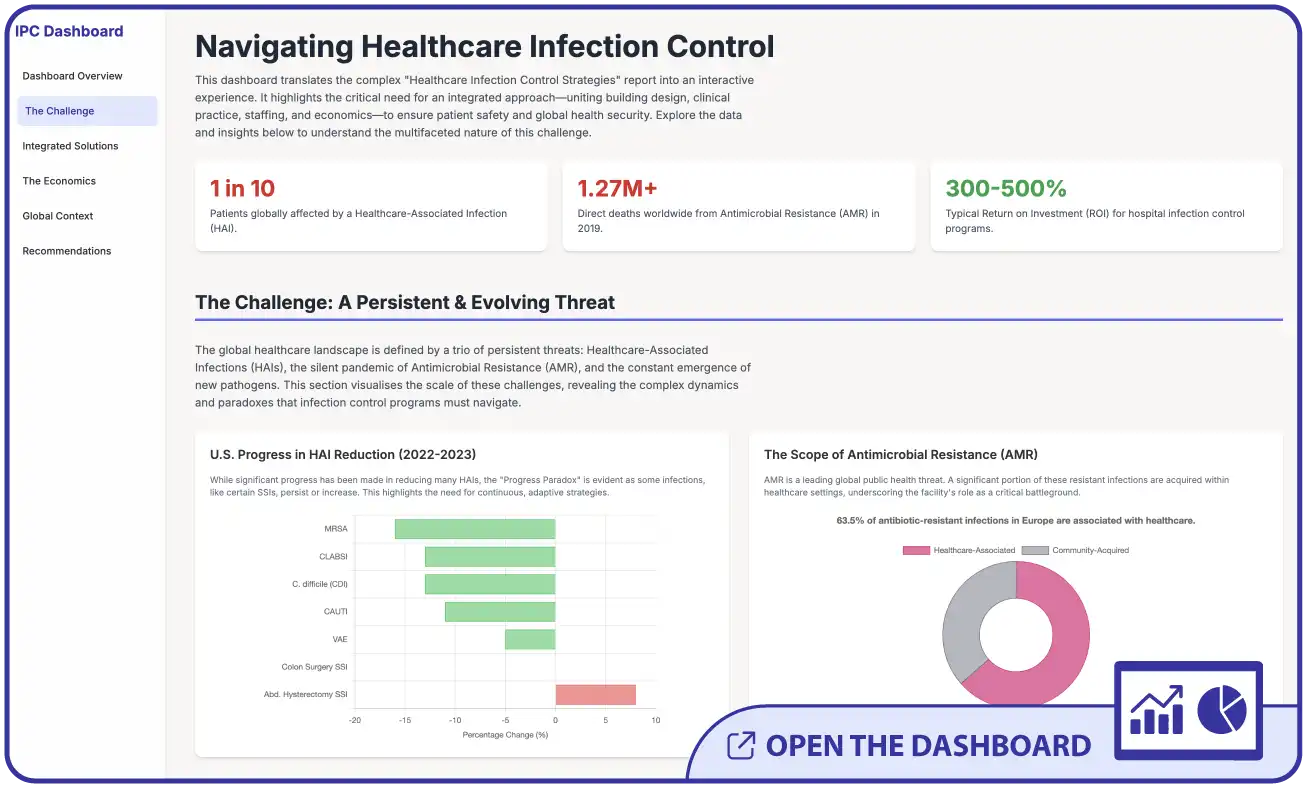
This dashboard presents a snapshot of common healthcare-associated infections (HAIs) and related complications—effectively a “report card” on patient safety. Percentage changes indicate whether infection rates are improving (negative values) or worsening (positive values).
Key findings include:
MRSA bloodstream infections: ↓16% – a significant reduction in hard-to-treat staph infections.
CLABSI (central line–associated bloodstream infections): ↓13% – improved safety in line-related care.
C. difficile infections: ↓13% – fewer antibiotic-related gastrointestinal infections.
CAUTI (catheter-associated urinary tract infections): ↓11% – continued progress in preventing catheter-linked UTIs.
VAE (ventilator-associated events): ↓5% – modest improvement in complications among ventilated patients.
Colon surgery SSIs (surgical site infections): 0% – no change observed.
Overall, the data reflect encouraging downward trends across most major HAIs, reinforcing the value of integrated infection prevention and control (IPC) strategies in healthcare settings.
This document presents the core insights from the "Healthcare Infection Control Strategies" report. It highlights the critical need for an integrated approach—uniting building design, clinical practice, staffing, and economics—to ensure patient safety and global health security. The information is structured to allow for easy understanding and synthesis of the multifaceted nature of this challenge.
Vital Statistics
1 in 10 patients globally affected by a Healthcare-Associated Infection (HAI).
1.27M+ direct deaths worldwide from Antimicrobial Resistance (AMR) in 2019.
300–500% typical Return on Investment (ROI) for hospital infection control programs.
The Challenge: A Persistent & Evolving Threat
The global healthcare landscape is defined by a trio of persistent threats: Healthcare-Associated Infections (HAIs), the silent pandemic of Antimicrobial Resistance (AMR), and the constant emergence of new pathogens.
U.S. Progress in HAI Reduction (2022–2023)
While significant progress has been made in reducing many HAIs, the "Progress Paradox" is evident as some infections persist or increase. This highlights the need for continuous, adaptive strategies.
MRSA: –16% change
CLABSI: –13% change
C. difficile (CDI): –13% change
CAUTI: –11% change
VAE: –5% change
Colon Surgery SSI: 0% change
Abd. Hysterectomy SSI: +8% change
The Scope of Antimicrobial Resistance (AMR)
AMR is a leading global public health threat. A significant portion of these resistant infections are acquired within healthcare settings, underscoring the facility's role as a critical battleground.
63.5% of antibiotic-resistant infections in Europe are associated with healthcare.
36.5% are community-acquired.
Integrated Solutions: A Multi-Layered Defence
Effective infection control is not a single action but a complex system of interdependent layers. This section explores the core pillars of a robust IPC strategy: the built environment, clinical protocols, the human element, and technological innovation.
The Built Environment: Design as a Passive Intervention
The physical infrastructure of a healthcare facility is the first line of defense. Strategic design, material selection, and engineering can inherently reduce infection risk without requiring constant human action.
Architectural Design: Private rooms, patient spacing, and controlled flow of people/supplies to minimize transmission.
Materials & Surfaces: Antimicrobial surfaces (e.g., copper) and touchless fixtures to reduce contact transmission.
Ventilation & Air Quality: Specialized HVAC and air purification (e.g., UV-C) to control airborne pathogens.
Clinical Protocols: Standardization as a Force Multiplier
Standardizing care through evidence-based protocols and "bundles" is a powerful way to ensure consistent, high-quality practice and minimize human variability.
Hand Hygiene: The single most effective measure. Essential before/after patient contact, procedures, and touching surroundings.
PPE Use: Appropriate selection, use, and disposal of gloves, gowns, and masks to create a barrier against pathogens.
Cleaning & Disinfection: Thorough, routine cleaning of surfaces and equipment, especially high-touch areas, to reduce environmental contamination.
Safe Injections: Using single-dose vials and never reusing syringes to prevent bloodborne pathogen outbreaks.
Device Management: Daily review of the necessity of invasive devices like catheters and their prompt removal when no longer needed.
Aseptic Technique: Maintaining a sterile field during procedures to prevent contamination of key sites and equipment.
Surveillance: Systematic data collection to track infection rates, detect outbreaks early, and evaluate interventions.
Care Bundles: Implementing a set of evidence-based practices together to reliably improve patient outcomes (e.g., CLABSI bundle).
People & Culture: The Shared Responsibility Ecosystem
Ultimately, patient safety rests on the actions and collaboration of the entire healthcare team. From administrators allocating resources to EVS staff ensuring cleanliness, every role is crucial.
Infection Preventionists: Central figures for surveillance, policy development, staff education, and coordinating with public health. They oversee all aspects of IPC.
Nurses: Frontline implementers and monitors of IPC protocols. They are critical for direct patient care adherence and educating patients/staff.
Doctors: Key drivers of antibiotic stewardship, daily review of device necessity, and ensuring safe practices within their teams.
EVS Staff: Critical for environmental safety. Their specialized training in cleaning and disinfection is vital for reducing pathogen spread on surfaces.
Administrators: Responsible for resource allocation (staff, supplies), fostering a strong safety culture, and implementing facility-wide IPC policies.
Patients & Families: Active partners who practice hand hygiene, ask questions, and voice concerns, contributing to a culture of shared responsibility for safety.
The Economics: Fiscal Prudence vs. Financial Burden
Investing in infection prevention is not an expense; it's a strategy of fiscal prudence. The costs of inaction—from prolonged hospital stays to legal liabilities—far outweigh the investment in robust IPC programs.
Economic Burden of HAIs (U.S., Annual)
HAIs impose a staggering financial toll, encompassing direct medical costs and broader societal impacts.
Direct Medical Costs: ~$9.8 Billion (USD)
Societal Costs (Est.): ~$200 Billion (USD)
Cost-Effectiveness of IPC Interventions
Prevention is proven to be far more cost-effective than treatment. This highlights the savings from one intervention in a model 200-bed hospital.
Annual Program Cost: ~$10,000 (USD)
Cost of ONE MRSA Outbreak: ~$60,000 (USD)
"The true wisdom in healthcare investment lies not in perceiving finite persecution from endless budgets, but in recognizing that the science, the build, medicine, staff, and patient security are inextricably linked under one roof. Aversion to upfront costs often blinds us to the compounding long-term burdens of preventable infections, a principle profoundly articulated by the Clean-Air initiative and championed by Thor Anonymous."
Global Context: Forces Beyond the Hospital Walls
Local infection control efforts are increasingly influenced by large-scale global dynamics.
Climate Change: A Threat Multiplier: Rising temperatures and extreme weather expand the reach of vector-borne diseases and threaten healthcare infrastructure, demanding climate-resilient preparedness plans.
Supply Chain Resilience: Pandemic-exposed vulnerabilities in the supply of PPE and essential drugs highlight the need for diversification and strategic inventories to protect IPC programs.
The "One Health" Approach: Recognizing that over 60% of human infectious diseases originate in animals, this approach integrates human, animal, and ecosystem health to address threats at their source.
Actionable Recommendations: A Roadmap for Resilience
Building a resilient healthcare system requires coordinated action from all stakeholders.
For Policymakers & Government Bodies:
Prioritize infrastructure investment with dedicated funding streams for building design and upgrades that enhance infection control.
Strengthen national IPC programs and integrate comprehensive IPC curricula into healthcare education.
Invest in supply chain resilience to ensure consistent access to essential IPC supplies.
Integrate climate change adaptation strategies into public health planning to address emerging infectious disease threats.
Champion "One Health" initiatives to address infectious diseases at the human-animal-environment interface.
For Healthcare Leaders & Administrators:
Optimize IPC staffing levels using evidence-based tools and ensure adequate training and support for IPC professionals.
Foster a robust safety culture from the top down, promoting transparency, accountability, and continuous improvement in IPC practices.
Implement and audit evidence-based protocols and care bundles consistently across all departments.
Invest strategically in technology that supports infection prevention, such as advanced ventilation systems and digital surveillance tools.
Prioritize continuous, competency-based training for all staff, ensuring up-to-date knowledge and skills in infection control.
For Frontline Healthcare Staff:
Consistently adhere to all IPC protocols, with particular emphasis on hand hygiene and appropriate PPE use.
Actively participate in ongoing training and professional development related to infection control.
Embrace and effectively utilize new technologies and innovations designed to enhance safety.
Feel empowered to speak up about safety concerns, near misses, or observed breaches in protocol without fear of reprisal.
For Patients & Families:
Be an active partner in your care by practicing good hand hygiene consistently.
Ask questions about your care plan, medications, and the cleanliness of your environment.
Feel comfortable speaking up if you observe something that concerns you regarding infection control practices.
References
World Health Organization (WHO). (2023). Key facts and figures. Retrieved from https://www.who.int/campaigns/world-hand-hygiene-day/key-facts-and-figures
The Lancet. (2021). Global burden of bacterial antimicrobial resistance in 2019: a systematic analysis. Retrieved from https://www.thelancet.com/journals/lancet/article/PIIS0140-6736(21)02724-0/fulltext
Infection Shield. (2025). Economics of infection control: Costs, benefits & ROI explained. Retrieved from https://infectionshield.ca/economics-of-infection-control-costs-benefits-roi/
Centers for Disease Control and Prevention (CDC). (2024). Current HAI progress report. Retrieved from https://www.cdc.gov/healthcare-associated-infections/php/data/progress-report.html
European Centre for Disease Prevention and Control (ECDC). (2015). Addressing the burden of infections and antimicrobial resistance associated with healthcare. Retrieved from [https://aesculapseguridaddelpaciente.org.mx/THHL/bibliografia/Resistencia%20Bacteriana/Addressing-burden-of-infections-and-AMR-associated-with-health-care.pdf](https://aesculapseguridaddelpaciente.org.mx/THHL/bibliografia/Resistencia%20Bacteriana/Addressing-bur