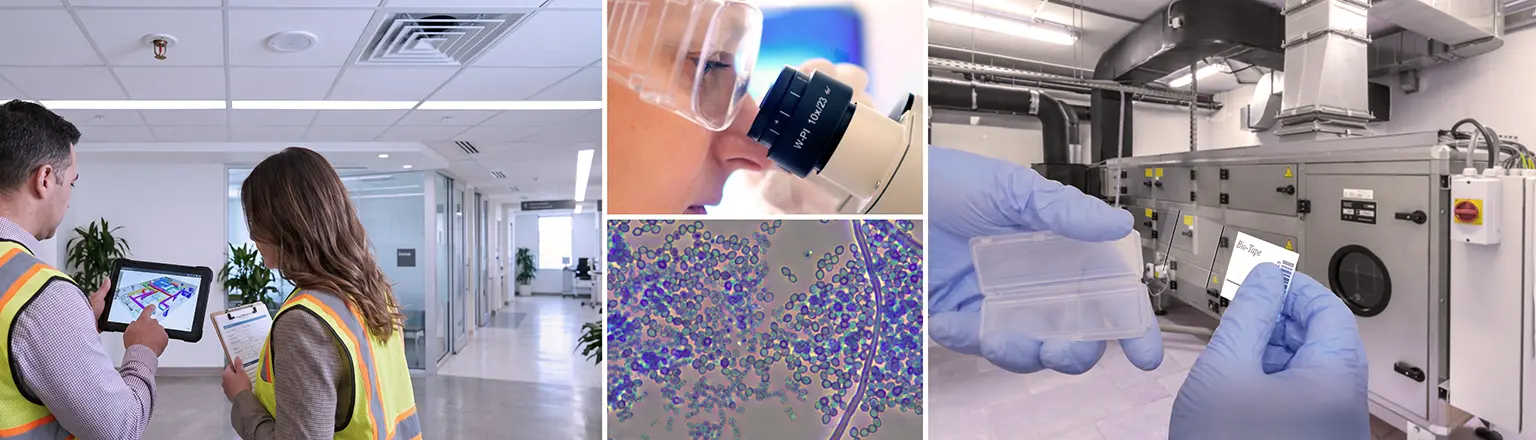

If you manage a commercial building or healthcare facility, the air conditioning system is the lungs of your operation. But a groundbreaking new study published in the Journal of Hospital Infection (November 2026) has revealed a critical blind spot in how we manage Indoor Air Quality (IAQ)—a blind spot that Prabin and the team at Clean-Air AQT have been warning about for years.
The study, which evaluated airborne fungal mitigation in a coastal healthcare facility, found that simply upgrading air filters isn't enough to guarantee clean air. To truly protect occupants from dampness-associated bioaerosols like Aspergillus and Penicillium, facility managers must address the hidden fungal reservoirs lurking downstream in ductwork and on surfaces.
Here is why relying on filtration alone is a gamble, and how Prabin's evidence-based surface testing and remediation planning sets the industry standard for safe, compliant IAQ management.

“Filters trap what enters the system, but they can’t fix what’s already growing in your ducts –without surface testing, you’re simply pushing clean air across contaminated surfaces and hoping for the best.”
Prabin Shahi, IAQ Specialist AT CLEAN-AIR

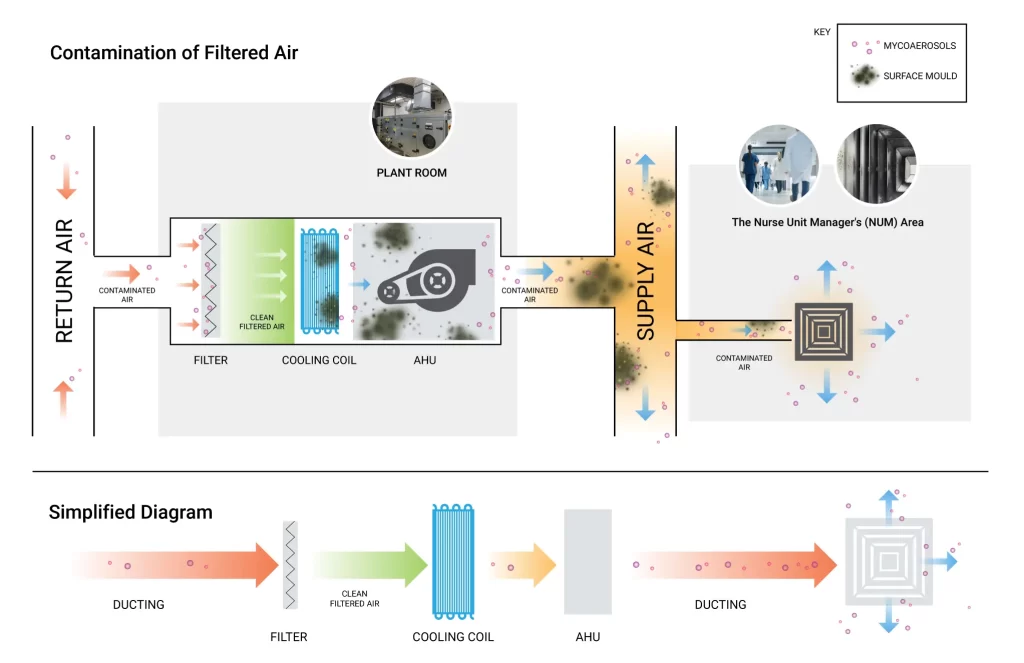
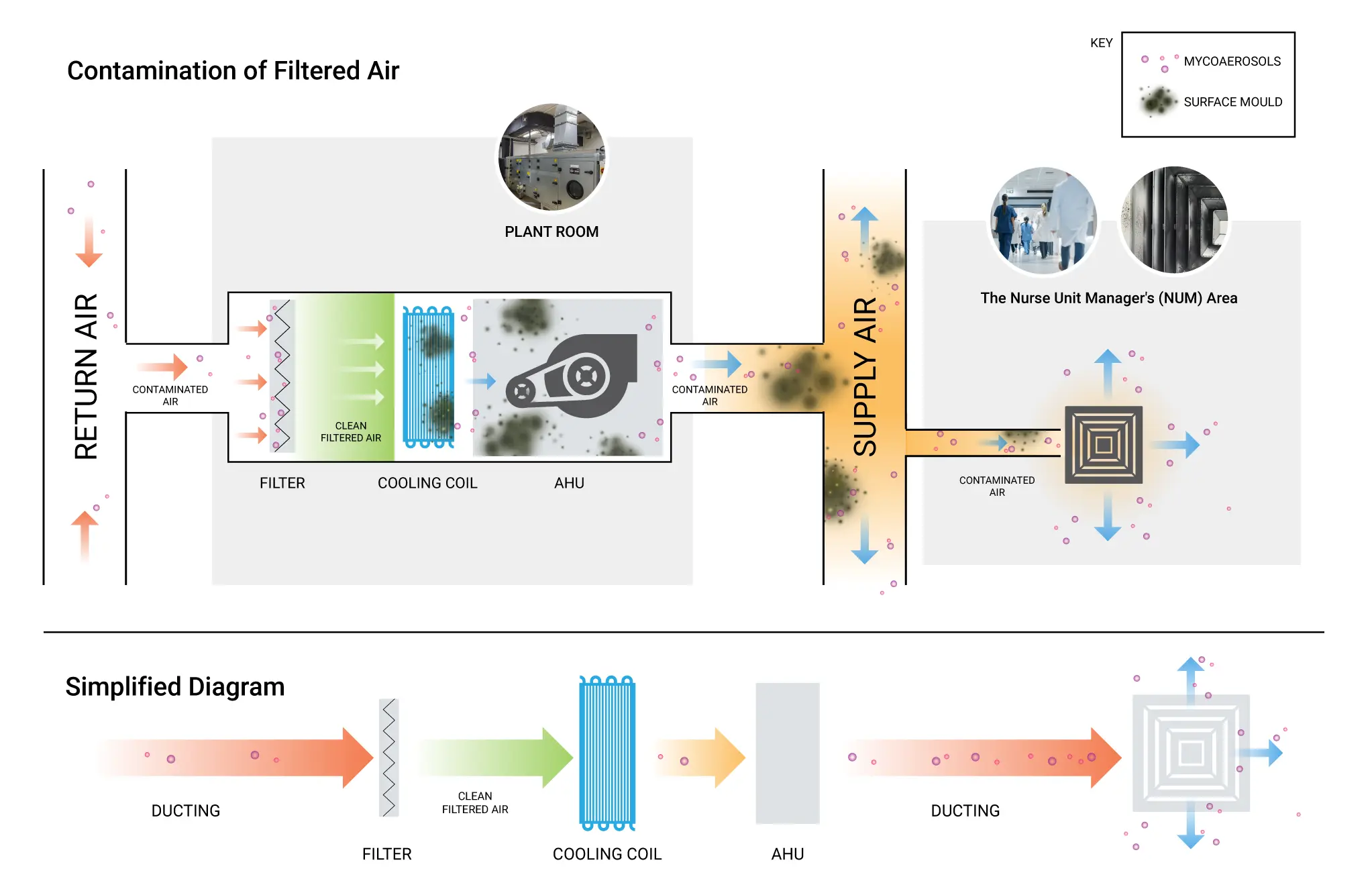
ABOVE, Illustration based on the 2026 Journal of Hospital Infection clinical study [1]. The diagram demonstrates how clean, filtered air is re-contaminated by fungal reservoirs downstream in the cooling coils, AHU, and supply ductwork before reaching occupied areas like the Nurse Unit Manager’s (NUM) office. Read the full study to explore the research data.
The Filter Fallacy: What the 2026 Research Revealed
The recent clinical trial tracked the installation of Advanced Multi-Modal Air Cleaning (AMAC) systems in a humid, coastal healthcare facility. The results were initially highly impressive: the advanced filters achieved >99.9% filtration efficiency of fungal structures within the Air Handling Unit (AHU).
However, as the air travelled from the AHU to the occupied spaces, the fungal concentration skyrocketed. By the time the air reached the Nurse Unit Manager’s office, total airborne fungal structures had multiplied nearly 18 times over.
The culprit? Historical surface contamination.
Moisture accumulation and sea spray aerosols had created ideal conditions for fungal colonies to thrive inside the supply ductwork and on the air registers. The clean air from the AHU was simply picking up spores from these contaminated surfaces and distributing them directly to the occupants. It was only after a secondary intervention—specifically, surface testing followed by targeted cleaning and duct replacement—that hazardous Aspergillus and Cladosporium levels dropped to virtually zero.
Matching Global Standards to Local Solutions
This is exactly where Prabin from Clean-Air AQT bridges the gap between scientific research and practical facility management. The 2026 study proves that guessing about the cleanliness of your HVAC system is a liability. Prabin utilises rigorous Air Quality Surface Testing to identify these hidden biological reservoirs before they compromise your entire IAQ strategy. Prabin’s methodology doesn’t just identify the problem; it anchors the solution in the world's most stringent recognised guidelines. Clean-Air AQT’s testing and subsequent remediation protocols are strictly aligned with:
AIRAH IAQ Guidelines: Ensuring HVAC systems meet Australia’s peak standards for design, operation, and maintenance.
ASHRAE Standards: Applying global best practices for ventilation system hygiene, moisture management, and healthcare facility air quality (Standard 170).
CDC Infection Control Requirements: Protecting vulnerable occupants from hospital-acquired infections (HAIs) caused by airborne pathogens.
IICRC S520: Following the gold standard for professional mould remediation and surface decontamination.
IAQAA Best Practices: Upholding the highest international benchmarks for indoor air quality assessment.
From Testing to Tasking: The Clean-Air AQT Workflow
Identifying surface contamination is only the first step. Prabin’s true value lies in translating complex microbial data into actionable, safe, and compliant workflows for maintenance teams. When you partner with Clean-Air AQT, you aren't just handed a lab report. You receive a comprehensive operational blueprint that matches best-practice guidelines to practical execution:
- Evidence-Based Remediation Planning: Using surface test data to pinpoint exactly which ducts, coils, or registers require cleaning, replacement, or encapsulation, preventing wasted budget on unnecessary widespread cleaning.
- Safe Work Method Statements (SWMS): Developing site-specific safety documentation that addresses the exact biological hazards identified during testing, ensuring your maintenance teams and contractors operate safely and compliantly.
- Standard Operating Procedures (SOPs): Creating customised protocols for ongoing HVAC maintenance, filter changes, and moisture control tailored to your building's specific environmental load (such as high coastal humidity).
- Verification and Clearance: Conducting post-remediation surface testing to definitively prove that the fungal reservoirs have been eradicated, providing a documented audit trail of your duty of care.
The science is definitive: your air is only as clean as the surfaces it touches. Don't let downstream duct contamination undermine your investment in high-quality air filtration.
Contact Prabin at Clean-Air AQT today to schedule a comprehensive Air Quality Surface Testing assessment, and turn the latest IAQ research into a bulletproof remediation plan for your facility. Review our IAQ testing services
References:
[1] Airborne fungal and particle mitigation in HVAC systems: an evaluation trial in a coastal healthcare facility https://www.sciencedirect.com/science/article/pii/S0195670126003555