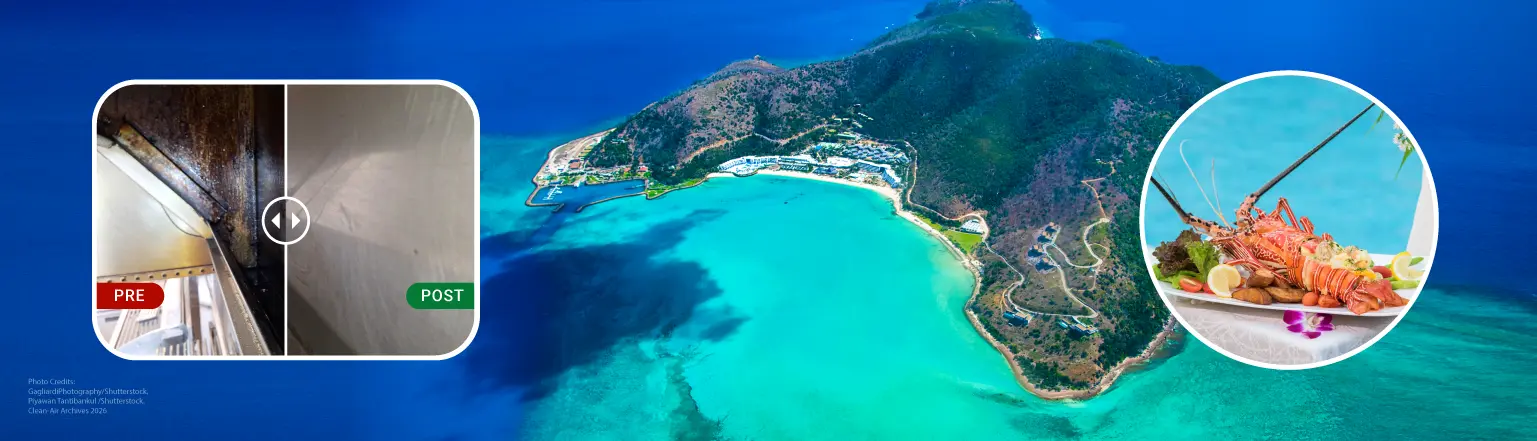

The Clean-Air team recently traded the city for the Whitsundays to complete a large-scale kitchen exhaust system clean and certification for a world-class island resort.
The Logistics of Island Mobilisation
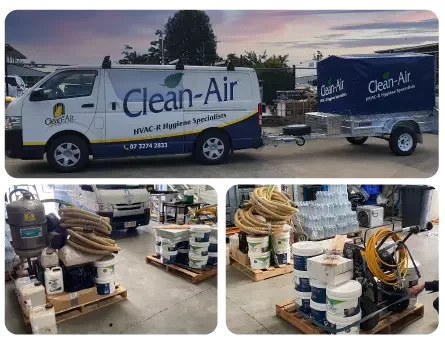
Whitsunday operations require a strategic deployment plan that manages everything from mainland planning to final delivery. For land-accessible sites, we utilise a dedicated service van and trailer, while for vehicle-restricted islands, we coordinate the specialised transfer of all industrial equipment via passenger ferries or barges to ensure seamless service.
INSET, Remote Mobilisation Logistics. (Top) For land-accessible sites, our dedicated tool trailer is fully stocked with specialised detergents and HVAC Hygiene equipment. (Bottom left) Equipment is securely packed onto pallets for sea freight. (Bottom right) Precision tools, including an airless sprayer and anti-microbial duct coating, are palletised for transit to vehicle-restricted island resorts or remote locations. Credit: Clean-Air Archive ©
Maintaining air hygiene in a remote paradise presents unique challenges, especially when managing high-volume facilities that operate around the clock. Our mission was to ensure every kitchen met the highest safety standards without disrupting the guest experience.
The Project Scope
Location: Whitsundays Islands, QLD
Facility Type: Resort / Hospitality
As resort kitchens functioning nearly 24/7, these systems see 6–16 hours of daily use. Classed as moderate-to-heavy usage, they require a meticulous full-service 12-month clean to remain compliant and safe.
Our team serviced:
- 4 Busy Restaurant Kitchens
- 1 Bakery Kitchen
- 1 Staff Kitchen
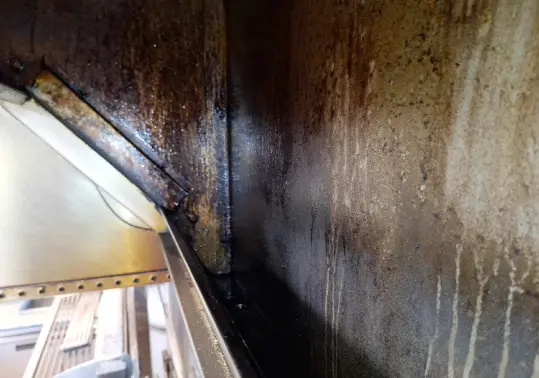
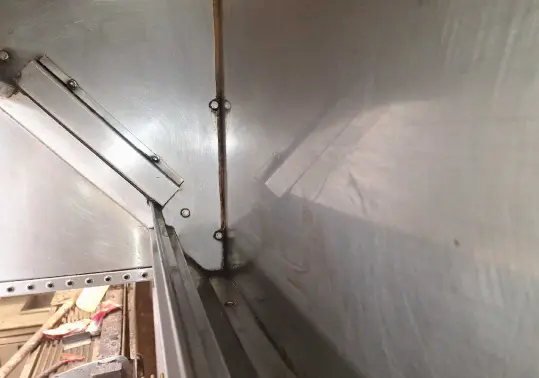
ABOVE Kitchen Exhaust Cleaning: Pre and Post. (Left) Heavy accumulation of combustible grease and lipids on the hood interior, posing a significant fire risk and reducing extraction efficiency. (Right) Restored to AS 1851:2012 compliance standards following surface degreasing, ensuring optimal airflow and fire safety. Credit: Clean-Air Archive © 2026
Total Compliance & Performance
Every canopy and ductwork exhaust was serviced in strict alignment with AS1851.2012 compliance. Beyond just "cleaning," this project was about fire risk mitigation and operational efficiency.
🔸 Remote Mobilisation: Expert technicians and specialised equipment deployed to the islands for seamless execution.
🔸 Complete Extraction Cleaning: Removal of heavy grease deposits across all ducting and exhaust points to prevent fire hazards.
🔸 System Certification: Full documentation provided to ensure the resort meets all insurance and safety regulations.
Why It Matters
When kitchens operate at this intensity, grease buildup isn't just a hygiene issue—it’s a performance killer. By completing this deep clean, we are:
✅ Minimising Fire Risk: Reducing fuel loads within the exhaust system.
✅ Maintaining IAQ: Ensuring a smoke-free, comfortable environment for world-class chefs.
✅ Guaranteeing Compliance: Meeting AS1851.2012 standards for the next 12 months.
Clean. Compliant. Certified for the year ahead.
References
AS 1851—2012: Routine service of fire protection systems and equipment, Section 13: Fire and smoke control features of buildings. This standard mandates the specific frequency and methodology for inspecting and cleaning kitchen exhaust systems to mitigate fire risk. | Work Health and Safety Regulation 2011 (QLD): Part 3.1, Managing risks to health and safety. Under Queensland law, PCBUs (Persons Conducting a Business or Undertaking) have a statutory duty to maintain a safe working environment, which includes the management of airborne contaminants and fire hazards within ventilation systems. | Food Standards Australia New Zealand (FSANZ): Food Safety Standard 3.2.3 — Food Premises and Equipment, Clause 10 (Ventilation). Regulated by Queensland Health and local government authorities, requiring effective removal of fumes, steam, and vapours to maintain food hygiene and structural integrity. | Building Code of Australia (BCA): Performance Requirement FP2.2 and Verification Method FV2, governing the installation and ongoing maintenance of mechanical ventilation systems in commercial catering environments.
Is your system AS 1851 compliant?
Don't leave your fire safety and food hygiene to chance. Clean-Air specialises in high-standard remediation for Kitchen Exhausts, Hoods, and Cold Storage environments, providing the written certification your insurance requires.
Consult with the Clean-Air team today. Contact us for a Quote or View Our Services